Jar label 01 · Airflow
Stop wiping the same dust every morning
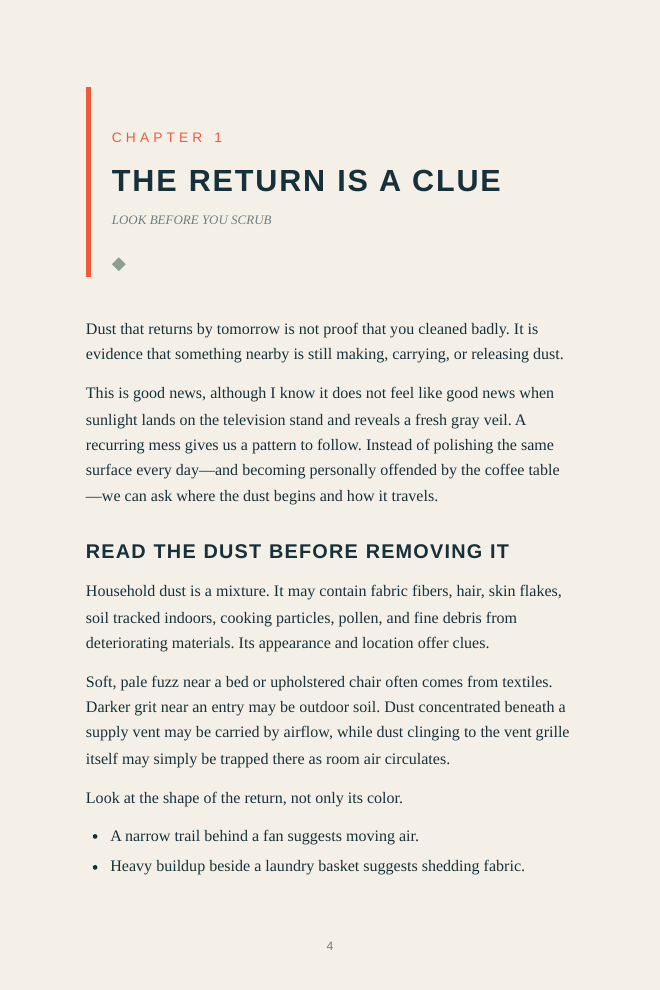
Trace fast-returning dust to overloaded filters, nearby vents, shedding fabrics, poor tool care, or dry methods that send particles back into the air.


The Hidden-Cause Household Handbook
Find the overlooked cause behind returning dust, odors, residue, stains, and mildew. Clean less, protect more, and help the work stay done.
Get instant PDF access — $37The return is a clue
A recurring mess is often less about effort and more about one condition that was never corrected.
Dust settles again before the cloth is dry. The kitchen cabinets feel sticky a few days after you washed them. A towel comes out of the laundry technically clean, yet still smells wrong. The bathroom mildew returns along the same line. The floor looks fine but feels tacky under bare feet.
It is easy to treat each return as proof that you need a stronger spray, more detergent, a stiffer brush, or another hour of scrubbing. Often, that only adds residue, spreads dirty rinse water, damages a finish, or leaves the real source untouched.
In this 59-page handbook, Mei Chen shows you how to pause before repeating the job. You learn to identify whether the likely cause is airflow, airborne oil, excess product, trapped moisture, minerals, detergent buildup, a slow leak, crowded storage, or a source hidden just beyond the obvious surface.
That distinction matters. Organic drain buildup and hard-water residue do not need the same treatment. Cloudiness from detergent is not the same as permanent glass etching. Soap scum, mildew, and a toilet ring are three different deposits. Treating them as one vague kind of “dirty” can waste time and put materials at risk.
“A home should feel cared for, not perfect. If something keeps returning, let us find out what it is trying to tell us.”
Remedy index
Each lesson begins with the symptom, traces the likely cause, gives a measured method, and explains where that method should not be used.
Jar label 01 · Airflow
Trace fast-returning dust to overloaded filters, nearby vents, shedding fabrics, poor tool care, or dry methods that send particles back into the air.
Jar label 02 · Airborne oil
Use staged degreasing, dwell time, and cloth rotation on cabinet fronts and range-hood surfaces without treating every finish as if it were stainless steel.
Jar label 03 · Sink deposits
Identify whether an odor comes from organic residue or whether a dull sink edge is hard-water deposit before choosing the next step.
Jar label 04 · Glass
Distinguish removable residue and minerals from scratches, damaged coatings, or permanent etching on windows and drinking glasses.
Jar label 05 · Floor residue
Use less product, cleaner rinse water, and an orderly mopping sequence suited to hardwood, laminate, vinyl, sealed tile, or natural stone.
Jar label 06 · Grout
Work below the tile surface and avoid repeatedly spreading dirty water across grout lines that seem to darken again as soon as they dry.
Jar label 07 · Bathroom moisture
Connect each deposit to soap chemistry, ventilation, mineral lines, lingering moisture, or a slow leak rather than using one harsh mixture everywhere.
Jar label 08 · Laundry
Address detergent buildup, crowded loads, damp seals, neglected dispensers, and drying habits without assuming another capful will solve it.
Jar label 09 · Fabric stains
Understand why residue reappears after drying, why heat can set a stain, and when wool, silk, dyes, or specialty garments need professional care.
Jar label 10 · Cold storage
Clean shelf by shelf while checking gasket folds, drawer channels, hidden drips, sticky tracks, and containers that are not fully sealed.
Jar label 11 · Storage air
Check for damp clothing, packed walls, cardboard, condensation, blocked airflow, and leaks before covering the smell with fragrance.
Jar label 12 · Prevention
Move through airflow, grease, water deposits, floors, bathrooms, laundry, refrigeration, and storage with a concise prevention checklist.
Instant PDF access, printable for your household binder.
From Mei’s home in Sacramento
I am Mei Chen. I am 57, and I live in Sacramento with my husband, Daniel. Our two children are grown and live nearby, but I still keep a small bedroom ready for their visits. This means the room is sometimes very tidy and sometimes becomes a quiet storage argument. You may know the type.
I learned household work in ordinary ways: doing chores with my mother, making mistakes in my first apartment, raising children, preparing for visitors, and slowly noticing which habits saved time and which ones only made me feel busy.
I do not believe a returning mess means you are lazy. Usually, one detail has been missed: the air is carrying dust back, the cloth is redistributing oil, too much cleaner is drying on the floor, moisture is lingering, or the odor source is tucked into a fold or channel.
My methods are affordable and practical, but they are not universal. I tell you when to test first, when a material needs different care, and when a problem is better handled by a manufacturer, garment professional, or qualified mold professional.
With practical care,
Mei

Introducing the first edition
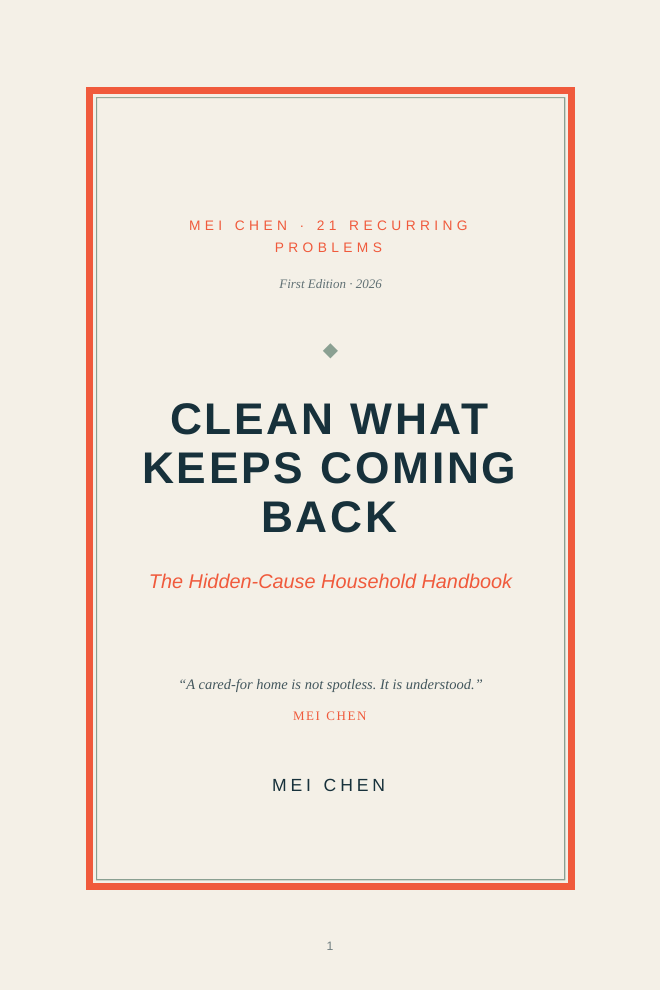
Clean What Keeps Coming Back: The Hidden-Cause Household Handbook is a 59-page guide to recurring dust, kitchen grease, sink deposits, cloudy glass, sticky floors, dark grout, bathroom buildup, laundry odors, returning stains, refrigerator smells, and musty storage.
Mei wrote it down because most cleaning advice begins with a product. This handbook begins with a question: What condition is allowing the problem to return?
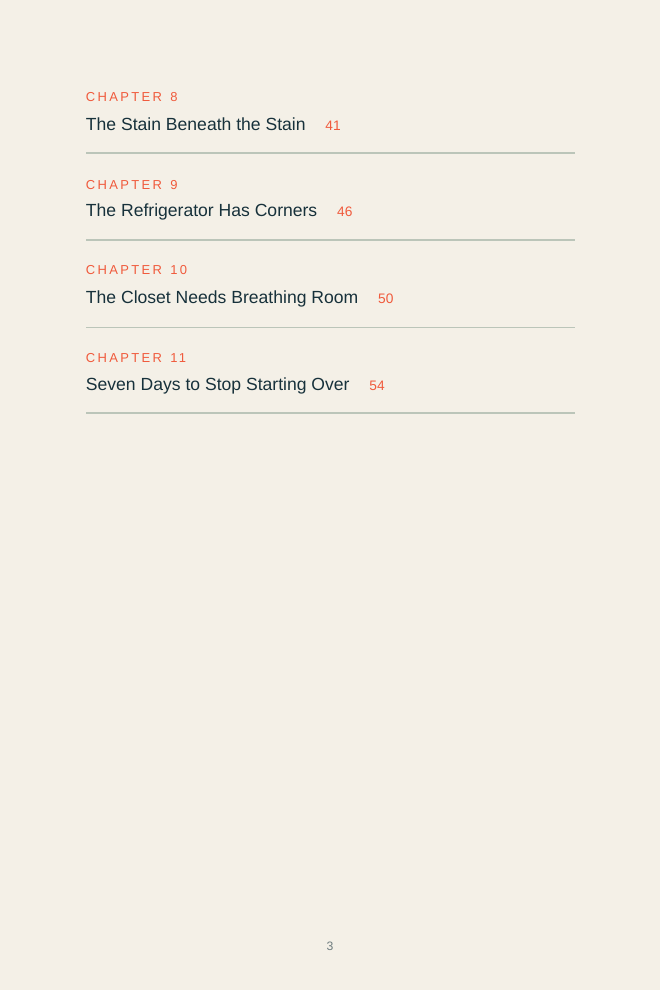
You can read from the beginning to learn the complete hidden-cause method, or open directly to the problem in front of you. The final chapter gathers the method into a manageable seven-day reset and a concise reference checklist.
The complete household edition
Download the handbook immediately, begin with the room that is bothering you today, and keep the reference pages for the next one.
Your edition includes
Open the handbook
This is a real, finished first edition arranged for calm reading, quick problem checks, and practical household reference.

Read immediately or print the pages you use most.
Plain answers
No. The book focuses first on identifying the cause and material. It explains practical methods, but it does not present one miracle mixture as safe for every surface. Common household chemicals can damage finishes or become dangerous when mixed, so the handbook includes clear limits and separation warnings.
The methods favor affordable tools, careful testing, correct product amounts, cloth rotation, drying, ventilation, and source removal. Some problems may require a manufacturer-approved product or professional service, but the book does not depend on a costly collection of specialty bottles.
The handbook identifies important limitations and tells you where general methods should not be used. It covers testing for painted wood, laminate, stainless steel, natural stone, coated glass, decorated glassware, hardwood, vinyl, wool, silk, dyed items, and dry-clean-only garments. Always follow the manufacturer’s instructions for your exact item.
It explains how moisture, ventilation, leaks, condensation, crowded storage, and porous materials contribute to recurring mildew and musty spaces. It does not replace professional assessment. Visible, extensive, recurring, or uncertain mold conditions should be evaluated by a qualified professional.
No. You may begin with the chapter that matches today’s problem. The seven-day reset is included to help readers who want a simple order for checking the whole home without attempting an exhausting cleaning marathon.
You will receive instant access to the PDF after purchase. You can read it on compatible devices or print it for personal household use. Free lifetime updates to this edition are included.
A careful guarantee
Your purchase includes a seven-day refund period. If the handbook is not the practical household reference you expected, request a refund within seven days of purchase according to the store’s refund process.
Clean the cause, not only the evidence
Begin with the dust, towel, floor, sink, bathroom line, refrigerator corner, or closet smell that has been asking for your attention. Find what keeps feeding it. Use the method that suits the material. Then add the small prevention habit that helps the work last.
Not a perfect home. A cared-for one—and fewer chores that make you wonder whether you did them at all.
Get Clean What Keeps Coming Back — $37Before you return to the cleaning cupboard
Get Mei Chen’s 59-page household handbook, including 11 practical chapters, the seven-day reset, material cautions, instant PDF access, and free lifetime updates.
Get the handbook — $37Covered by a seven-day refund period.